Underwriting a Westminster Site in 2026: The First Lender Question, and the Five-Sub-Zone Answer
If you are underwriting a Westminster site in 2026, the first lender question is no longer about value per square foot. The borough average still sits comfortably above £1,200 per square foot, which clears the £650 London viability line by a factor of two. The first lender question is which of the five Westminster sub-zones the site sits in, because Mayfair, Marylebone, Paddington Basin, Pimlico and St James’s are now priced as five different boroughs sharing a postcode. The borough-wide -10.8% year on year is the average of those five, not a property of any one of them.
This piece is the credit-committee read on a Westminster underwrite in 2026. The five-sub-zone framework, the senior LTGDV and margin band each one attracts, why the regen pipeline gets near-outer pricing while the super-prime end attracts very thin senior appetite, and what an IM has to say on the first page to get a tight term sheet rather than a wide one. The headline -10.8% is real and worth respecting, but it is not the operative number on a live Westminster underwrite.
What -10.8% actually means in a borough this big
Westminster is the largest of the prime central boroughs by both land area and economic mix. It runs from St James’s and Mayfair in the south-east, through the West End, Marylebone and Fitzrovia in the centre, up to Paddington and Maida Vale in the north-west, and across the river-facing Pimlico and Westminster proper in the south. Average resi values across that footprint still sit comfortably above £1,200 per square foot. A scheme in Westminster clears the £650 per square foot London viability line by a factor of nearly two on price alone. This is not a viability story.
What -10.8% does is drag the whole borough through a margin compression. A site acquired in 2021 at £1,300 per square foot residual against a then-credible GDV of £1,950 is now being valued against a GDV of £1,700 to £1,750 on like-for-like comparables. RICS BCIS has gone the other way over the same window, up roughly 18%. The combined effect compresses margin into the band where senior lenders ask harder questions and require larger sponsor commitments, even though absolute values still clear comfortably.
The borough is not below viability. It is below the margin band the equity stack was originally underwritten on. That distinction sets up everything else in 2026.
The sub-zone anatomy: five boroughs sharing a postcode
The single most important thing about Westminster in 2026 is that it does not move as one market. The borough-wide -10.8% is the average of five distinct sub-zones with materially different demand depth, buyer mix and lender appetite.
Mayfair (W1J / W1K) and Belgravia (SW1X / SW1W)
The international super-prime end. This is where the correction is sharpest in absolute and percentage terms. Anything above £20m has the thinnest demand depth of any segment of the London market, and the correction reflects soft sovereign and ultra-HNW capital flow alongside non-dom regime uncertainty. New-build resi-led at this scale is largely paused. What does transact is sponsor-balance-sheet led, with very thin senior debt appetite and almost no mezzanine appetite. Trophy townhouse repositioning still works because the construction-to-exit window is short.
Marylebone (W1U / W1G) and Fitzrovia (W1T / W1W)
The most resilient sub-zone in the borough. Domestic prime, deeper end-user demand, less exposure to the international super-prime swing. Marylebone Village product between £4m and £12m has held within five percentage points of peak. New-build origination in Fitzrovia mid-rise is still being structured at meaningful margin, and bridging-led refurb plays clear here without the trajectory caution that sits across Mayfair and Belgravia.
Paddington Basin and Marylebone West (W2)
The regeneration sub-zone. The Paddington Basin pipeline (Merchant Square, Paddington Square, the Brunel Building cluster) and the Marylebone West / Edgware Road regen frontage are still moving in 2026. Lender pricing in this corridor sits closer to the outer-London growth band than to prime central: 65% LTGDV on consented schemes, senior at 6.75 to 7.25%, BTR forward funding active. The product is structured for institutional take-out from day one rather than retrofitted from open-market sale.
Pimlico, Victoria and Westminster south (SW1V / SW1P / SW1H)
The family-prime and mansion-block belt. The correction has been more uneven here. Sutton Estate / Grosvenor Estate stock has been resilient. Some of the post-2018 new-build between Victoria Street and Vauxhall Bridge Road is down meaningfully more than the borough average where the absorption profile was institutional. Value-add reposition on dated mansion-block flats is the most active corner.
St James’s and the West End (SW1Y / SW1A)
Mixed-use territory dominated by commercial. The resi exposure is small and concentrated at the super-prime end, behaving similarly to Mayfair. Active deal flow is mostly commercial repositioning to higher-spec resi or hotel use, where the underwriting is on the commercial value chain rather than the residential one.
The takeaway: when a lender sees “Westminster” on a term sheet in 2026, they are no longer pricing one market. They are pricing one of five. A Marylebone Village reposition and a Belgravia super-prime new-build do not sit in the same risk bucket and do not get the same terms. Term sheets that do not specify the sub-zone are being mispriced.
What is moving the borough number
Three forces compound to deliver the headline -10.8%, and the relative weight of each varies by sub-zone.
The first is international buyer activity, which has remained structurally lower than the 2014 to 2019 baseline. Stamp duty reforms, non-dom regime changes, and a stronger sterling against several historical buyer currencies have all weighed on demand depth at the £3m-plus end where Mayfair and Belgravia volumes concentrate. This is a five-year drift that has now compounded into a thin-bid market at the super-prime end. It does most of the work in the southern half of the borough.
The second is the supply of high-end stock arriving into that thinner market. Several large completions through 2024 and 2025 added inventory in a softer demand environment than developers underwrote when sites were acquired in 2018 to 2021. Some of that stock has cleared, much has not, and the discount required to clear the residual has dragged down the comparable set. This shows up most clearly in Pimlico/Victoria and the Belgravia fringe.
The third is the relative-rate pull. With outer-London transport-anchored boroughs delivering price growth, capital that historically anchored prime central is finding yield and trajectory elsewhere in the city. That rotation does not finish by H2 2026. It compounds.
What does not show up in the borough-wide number, but matters for the financing picture, is the active regen pipeline in Paddington and along the Marylebone West frontage. That product is not transacting against the prime-central correction. It is transacting against institutional yield and absorbs a meaningful share of the borough’s 2026 dev-finance capacity.
How lenders are pricing Westminster in 2026
Senior debt in the prime central correction zone is materially tighter than in connected outer London. A typical Mayfair, Belgravia or central-Westminster scheme is pricing 50 to 100 basis points wider than the equivalent Walthamstow or Bromley scheme on senior debt, with LTGDV ratios capped 5 percentage points lower (60 to 65% in the correction zone vs 65 to 70% in connected outer). Stretched senior products are available only with strong sponsor balance sheets and demonstrable cost-plan certainty.
Mezzanine finance appetite is thinner in Westminster than in K&C, partly because the borough’s super-prime concentration is harder for mezz funds to underwrite and partly because the regen-zone product takes the BTR forward funding route instead. Where mezz prices, it sits at 13 to 14% per annum with a materially smaller pool. JV equity providers are demanding 22 to 28% IRR targets versus 18 to 22% in the outer growth zone. The IRR widening is not pricing the level of value. It is pricing the trajectory of value through the construction window.
Forward funding for institutional take-out (BTR or PBSA) is the structurally active product in Westminster, and this is where the borough differentiates from K&C. The Paddington Basin and Marylebone West regen pipelines have been built explicitly for institutional take-out. BTR pricing at 5.5 to 6.0% net yields is what makes the regen-zone underwriting work, and it is what allows stalled prime-central completions to find a balance-sheet exit at 20 to 25% discounts to original peak underwriting.
Bridging loans remain very active in the borough, particularly in Marylebone, Pimlico and the Paddington fringe. Refurbishment, change-of-use and land-assembly plays are the most resilient corner of the prime central market. Bridging in Westminster is pricing 0.65 to 0.85% per month on credible value-add stories, with the wider end of that range applying to the super-prime sub-zones where the exit is to a thin-bid HNW buyer pool.
What is actually transacting in Westminster in 2026
Four categories of activity dominate Westminster deal flow in 2026, and each carries a distinct capital structure.
1. Regeneration-zone forward funding (the dominant category by volume)
Paddington Basin and Marylebone West schemes built for institutional take-out. The capital structure is regen-zone senior at 65% LTGDV, BTR forward funding at 5.5 to 6.0% net yields, and a meaningfully shorter equity stack than super-prime resi. This is the most active corner of the borough by financed GDV in 2026 and the most straightforward for credit committees, because the take-out is institutional rather than open-market.
2. Value-add reposition (the dominant category by deal count)
Mansion-block, townhouse and large-flat refurbishments across Marylebone, Pimlico and the Paddington fringe where the GDV uplift on completion is meaningful, the construction window is short (9 to 14 months), and the exit is to a high-net-worth end-user rather than an institutional take-out. Bridging plus a refurb-loan stack works here. Easiest corner of the borough for credit committees because trajectory exposure is short.
3. Development exit refinance on completing schemes
Several mid-rise resi schemes that broke ground in 2022-2023 are completing through 2026 into a softer absorption environment than originally underwritten. Development exit refinance is doing real work, giving the original senior facility room to roll while the marketing window stretches. This is a very different deal flow from new-build origination, and one of the largest categories of Westminster activity in current pipeline.
4. Institutional conversion of soft open-market schemes
A meaningful share of late-2024 and 2025 super-prime completions has shifted from open-market sale to BTR or institutional rented residential balance sheets at 20 to 25% discounts to original underwriting. The institutional yield support holds the values up where the open-market thin demand does not, and this is where the senior pool re-engages with reasonable terms in the southern half of the borough.
What is much smaller in 2026: ground-up new-build resi-led origination on rare consented sites in Mayfair, Belgravia or central Westminster. The capital stack on a fresh super-prime new-build start now requires meaningful equity (35%-plus of cost), a strong sponsor track record specifically in prime central, and a clear product differentiation argument that the lender can underwrite the trajectory through. That deal flow is real but small.
How Westminster differs from K&C inside the lender pool
K&C and Westminster are both in the prime central correction zone for capital allocation purposes. The 2026 capital stack pricing referenced above applies in both boroughs with marginal variation. But there are three meaningful differences in how lenders price them.
First, the regen pipeline. K&C has very limited convertible product. Westminster has Paddington Basin, the Marylebone West frontage and the Old Oak Park Royal opportunity area immediately adjacent. That regen pipeline absorbs a meaningful share of Westminster’s 2026 senior debt capacity at near-outer-London pricing, which K&C cannot match.
Second, the sub-zone spread. K&C runs broadly from Knightsbridge to Notting Hill across four sub-zones with similar demand profiles. Westminster spans super-prime international (Mayfair, Belgravia), domestic prime (Marylebone, Fitzrovia), regen (Paddington), family prime (Pimlico) and commercial-led (St James’s). That is a wider spread of risk profiles inside one borough name, and it changes how a credit committee reads the term sheet.
Third, the institutional/commercial mix. Westminster has a meaningful share of mixed-use and commercial-to-resi reposition that K&C does not. The underwriting on a Westminster mixed-use scheme is structurally different from a K&C townhouse refurb, even when the headline correction is similar.
The counterpoint: same lender pool, opposite end of the market
The same lender pool that is capping LTGDV at 65% on a Mayfair senior debt facility is happy to push to 70% on a Walthamstow town-centre scheme at half the residual value per square foot. That is not irrational. It is precisely the trajectory pricing at work. A £700 per square foot scheme on a rising-value path has tailwind in the underwriting model. A £1,200 per square foot scheme on a falling-value path does not, even though both clear the £650 viability threshold by very different margins.
The interesting Westminster-specific wrinkle is that the regen-zone product (Paddington Basin and Marylebone West) gets priced closer to the Walthamstow band than to the Mayfair band by the same lenders, because the institutional take-out re-anchors the trajectory question. That is the structural reason Westminster has more financed activity than K&C in 2026 despite a similar borough-wide correction.
What recovers the picture
Three forces could move the Westminster trajectory through 2026 and into 2027.
First, a meaningful international buyer recovery, particularly from US and Middle East flows. The US dollar trajectory matters here, as does any clarification of the non-dom regime that reduces uncertainty for international long-term buyers. This re-rates the Mayfair and Belgravia sub-zones first, and feeds through to Pimlico and South Westminster within two to three quarters.
Second, further Bank Rate cuts that compress the yield gap between prime central residential and gilts. The December 2025 move to 3.75% started this. Each subsequent 25bp cut compounds directly into the equity IRR threshold and lifts BTR forward-funding pricing across the regen pipeline.
Third, supply discipline. The 2024-2025 completion wave is now largely absorbed or repositioned. New-build origination at the super-prime end is well below 2018-2021 run-rate. By H2 2026 the supply side will be tighter than at any point in the last cycle, and that creates pricing power even in a thin-bid market.
None of these arrive on a defined timeline. They are the things to watch in the rate, capital flow and policy reads through the back half of 2026.
What this means for Westminster site acquisition in 2026
If you are pricing a Westminster site, a refurb opportunity, or a regen-zone forward fund in 2026, three things matter more than they have in any recent cycle.
One. The sub-zone matters more than the borough name. Marylebone and Paddington Basin underwrite differently from Mayfair and Belgravia. A term sheet that does not specify the sub-zone is being mispriced. Get the sub-zone, the postcode and the buyer profile on the first page of the IM.
Two. The exit route is the gating question. Open-market sale at original peak underwriting is mostly not the answer in 2026. BTR forward funding at 5.5 to 6.0% net yields is the answer for institutional product. Value-add reposition to HNW end-user is the answer for short-window refurbs. Anything that does not have a clear exit route in one of those two structures is not getting senior debt at competitive terms.
Three. The construction window is now a significant variable. Short-window value-add (9 to 14 months) is the most financeable corner of the borough. Long-window new-build (24 to 36 months) carries the most trajectory exposure, and lenders are pricing that exposure into the senior margin and the equity IRR. A regen-zone forward-fund deal at 20 to 24 months sits in between.
For full prime-central data, transaction-level references and capital stack benchmarks behind this analysis, see the Greater London Property Market Report 2026. Borough-specific intelligence sits on the Westminster, Mayfair, Marylebone and Paddington location pages.
See also: Walthamstow +5.9% on YouTube and The £650/sq ft Cliff on YouTube.
Listen to the full episode
For the dedicated deep dive on this borough, we have published a stand-alone Westminster episode of the Construction Capital podcast: Westminster -10.8%: Where Prime Is Pricing Now. Around ten minutes covering the five-sub-zone anatomy, the trajectory pricing the lender pool is applying, the full April 2026 prime-central capital stack with the Westminster-specific regen-zone band, and what is actually transacting across Mayfair, Marylebone, Paddington and Pimlico in 2026.
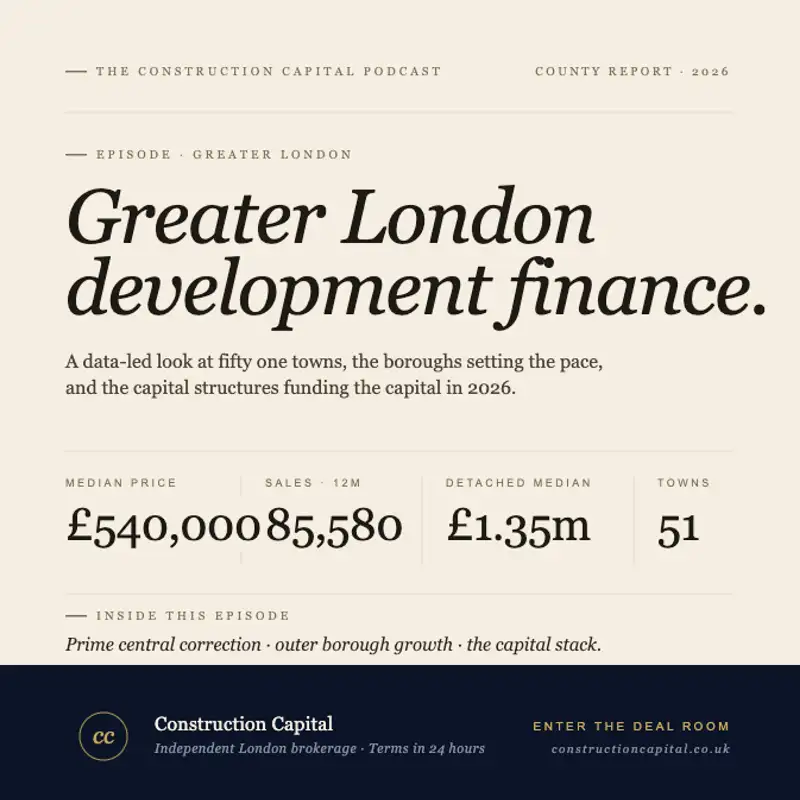
This article also draws on Episode 2 of the Construction Capital podcast: Greater London Property Development Finance 2026: Market Analysis, House Prices and Lending Outlook.
Listen anywhere
Listen on Apple Podcasts, Spotify, Overcast, Pocket Casts, or Amazon Music.
For prime-central terms within 24 hours, submit through the Construction Capital deal room. Construction Capital sources terms from over 100 lenders across development finance, bridging, mezzanine and equity.
Published by Construction Capital, an independent capital advisory brokerage sourcing terms from over 100 lenders across development finance, bridging, mezzanine, and equity. This article is part of a 20-piece Greater London 2026 series accompanying the Construction Capital podcast.